Cohort Workshop on OBE, PEO–PO–CO Mapping and Attainment Calculation
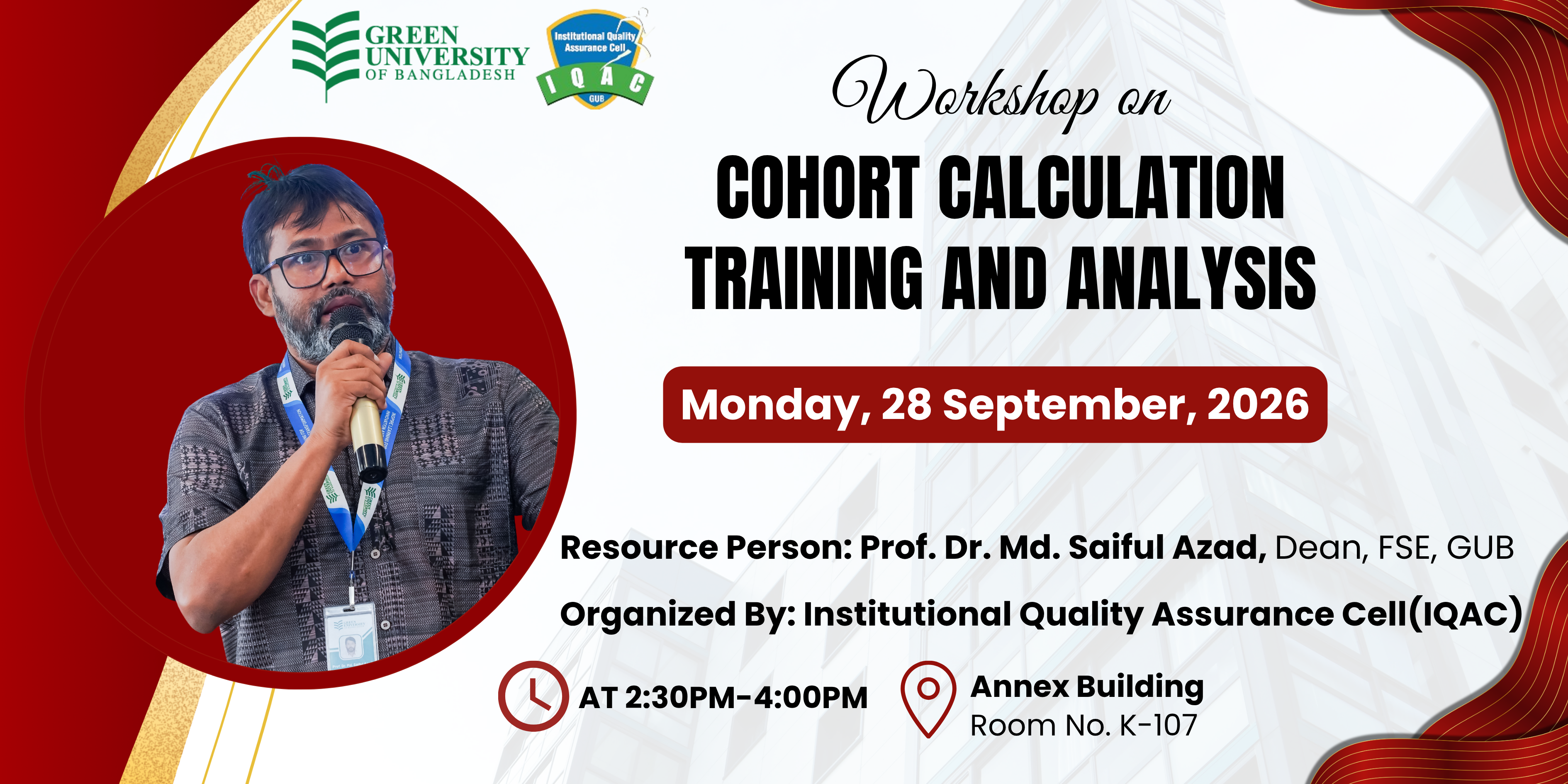
The Institutional Quality Assurance Cell (IQAC) successfully organized a workshop titled “Workshop on Cohort Calculation Training and Analysis” on Monday, 28 September 2026, for the PSAC committee members of the Departments of Textile Engineering, English (ENG), Green Business School (GBS), Law, Sociology, and Journalism and Media Communication. The session was designed to strengthen the participants’ understanding of OBE (Outcome-Based Education), PEO, PO, CO mapping, outcome attainment, cohort analysis, and the preparation of evidence required for BAC accreditation.

The training session was conducted by Prof. Dr. Md. Saiful Azad, Dean, Faculty of Science and Engineering (FSE), who served as the resource person. He began the session with a comprehensive discussion of Program Educational Objectives (PEOs), Program Outcomes (POs), and Course Outcomes (COs), emphasizing their interrelationship within an OBE-based academic framework.
During the session, Prof. Dr. Saiful Azad explained how COs contribute to the achievement of POs and how POs collectively support the attainment of PEOs. He also demonstrated the overall OBE implementation framework and discussed the importance of maintaining a clear alignment among the different levels of program outcomes.

A significant portion of the training focused on the relationship between the University Vision, University Mission, PEOs, POs, and COs. The speaker emphasized that program-level educational objectives should be aligned with the broader vision and mission of the University. He further highlighted the importance of providing clear documentary evidence demonstrating how the PEOs are being achieved, particularly in the context of accreditation and PSAC documentation.
The session also addressed the cohort-based attainment calculation, which was one of the major focuses of the training. Participants were introduced to the process of designing survey questions for measuring PEO and PO attainment. The speaker explained that survey questions should be designed to measure the relevant PO indirectly rather than asking respondents to evaluate the PO or PEO in a direct manner. He emphasized that each survey question should be appropriately aligned with a specific PO and that every PEO should be connected to at least one PO.

The speaker further explained the appropriate selection of survey participants for cohort analysis. In particular, the session highlighted the importance of collecting responses from graduates who completed their program approximately three to five years earlier, allowing the university to assess whether the intended program educational objectives have been achieved after graduation.
Another important aspect discussed during the session was the presentation of comparative cohort results. Prof. Azad noted that presenting attainment results from two different graduating cohorts can provide useful evidence of progress and improvement and can help demonstrate the effectiveness of program-level interventions during accreditation visits.
The session also highlighted important considerations regarding CO–PO mapping. The speaker explained the required mapping relationship and emphasized that the mapping should maintain a clear and justifiable alignment. He illustrated that multiple COs may contribute to a single PO where appropriate, while a single CO should not be unnecessarily mapped to multiple POs when the intended outcome does not support such mapping.
A particularly practical component of the training was the demonstration of the Python-based cohort calculation tool. Prof. Saiful practically executed the cohort calculation process in front of the participants and demonstrated how the tool can be used to calculate attainment scores. He also explained the underlying logic and equations used in the calculation so that PSAC members could understand not only how to operate the tool but also how the final attainment scores are generated.

The participants were also introduced to the importance of presenting cohort attainment results through appropriate visual representations. The speaker emphasized the use of a radar/spider chart to present the comparative attainment of different POs/PEOs in a clear and visually understandable manner. Such graphical representation can provide accreditation reviewers with a concise overview of program outcome attainment.

Following the practical demonstration, Prof. Azad provided an overall summary of the major issues discussed during the training. He reiterated the importance of maintaining consistency among PEO, PO, and CO, ensuring proper mapping, designing appropriate survey instruments, accurately calculating attainment, and maintaining adequate documentary evidence for accreditation purposes.
The session concluded with remarks from Dr. Mohammed Nazmus Shakib, Additional Director, IQAC, who expressed his appreciation to all the PSAC members for their active participation in the training. He also conveyed special appreciation to the keynote speaker, Prof. Dr. Md. Saiful Azad, for dedicating his valuable time and for delivering an insightful, practical, and meaningful training session.
Latest Events
Find Us
- Purbachal American City, Kanchan, Rupganj, Narayanganj-1461, Dhaka, Bangladesh
+880-9614-482482, 01324-713502, 01324-713503, 01324-713504, 01324-713505, 01324-713506, 01324-713507, 013247-13508
- addmission@green.edu.bd
Departments
Centers
- Center for Career Development (CCD)
- Center for Language and Cultural Studies (CLCS)
- Centre for Research Innovation Transformation and Sustainability (CRITS)
- Center for International Affairs (GCIA)
- Center of Excellence for Teaching And Learning (CETL)
- Center for Continuing Education (CCE)
- Institutional Quality Assurance Cell (IQAC)
Offices
- Office of the Vice Chancellor
- Office of the Pro Vice Chancellor
- Office of the Treasurer
- Office of the Registrar
- Office of the Exam Controller
- Office of the Admission
- Office of the Accounts
- Office of the GCITS
- Office of the Proctor
- Office of the Library
- Coordination Office
- Office of the Public Relation
- Office of the Student Affairs
- Medical Center
- Office of Logistics
- Others Office
© 2003-2026 Green University of Bangladesh. All Rights Reserved.
Developed by GCITS